
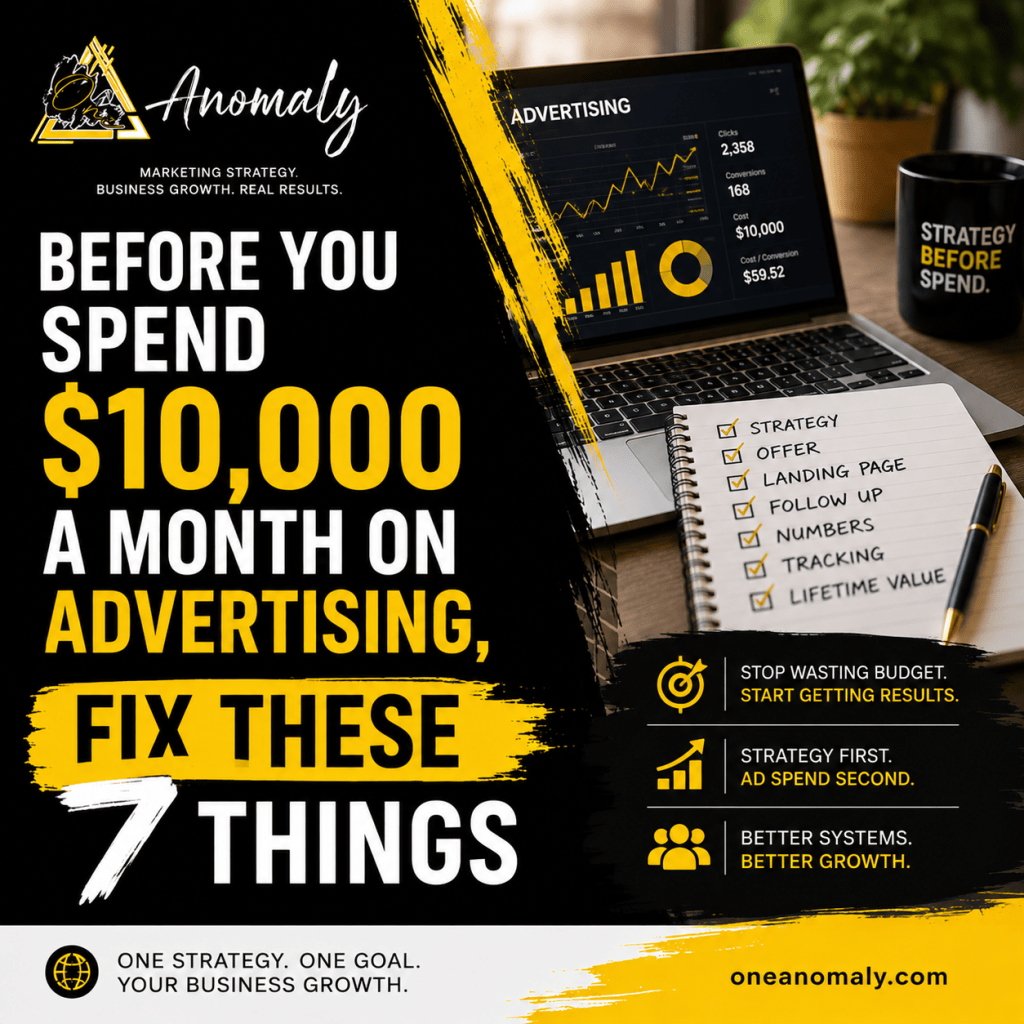
A $10,000 monthly advertising budget can generate serious business growth.
It can also waste $120,000 a year surprisingly quickly.
The difference isn’t simply whether you choose Google Ads, Meta Ads or another platform. Advertising works within a larger customer acquisition system. If that system is weak, increasing ad spend often means paying to send more potential customers into a process that doesn’t convert them.
Before significantly increasing your advertising budget, make sure these seven areas are ready.
1. Know Exactly What You’re Trying to Sell
“Generate more leads” isn’t a sufficient advertising objective.
Which customers do you want? For which services? In which markets? And what commercial result should the campaign produce?
A company offering several services may discover that certain services have stronger margins, higher customer lifetime value or greater capacity for growth.
Your advertising strategy should reflect those priorities.
Before spending $10,000 per month, management should be able to answer:
What are we selling, who are we targeting, why should they choose us and what is a successful customer worth?
Without those answers, targeting becomes broad, messaging becomes generic and budget gets distributed without a clear commercial purpose.
Advertising should support the business strategy, not determine it.
2. Make Sure Your Offer Is Actually Competitive
Advertising creates visibility.
It doesn’t automatically create desirability.
If a prospective customer sees your advertisement and immediately finds competitors with stronger positioning, better proof, clearer value or a more compelling offer, spending more won’t solve the problem.
This doesn’t mean you need to discount your services.
It means customers need a convincing reason to choose your business.
Review your offer from their perspective.
Is the value clear? Is your positioning differentiated? Are you communicating why your company is the appropriate choice? Does your reputation support your claims?
If your only differentiator is “quality service,” you may have a positioning problem.
Your advertising shouldn’t have to work overtime explaining a business proposition that isn’t clear.
3. Fix Your Website and Landing Pages
Getting the click is only half the job.
Your website has to convert the visitor.
Google explicitly recommends aligning landing pages with the advertisement and keywords that brought visitors there. It also advises businesses to make pages mobile-friendly, easy to navigate and simple for customers to take the intended action.
Imagine paying $15 for every website visitor.
If 1,000 people visit, you’ve spent $15,000.
Improving how effectively those visitors convert can sometimes create more growth than purchasing another 500 clicks.
Before scaling advertising, examine your landing pages.
Can visitors immediately understand what you’re offering? Does the page match what the advertisement promised? Is there a clear next step? Can mobile users easily call, enquire, book or purchase?
Google also considers landing-page experience when assessing search-ad quality.
Your website isn’t decoration around your advertising.
It’s part of the conversion system.
4. Make Sure You Can Handle the Leads
This is where marketing problems become operational problems.
Imagine your advertising works beautifully.
Lead volume doubles next month.
Can your business handle it?
Who answers the calls? How quickly are enquiries followed up? What happens to missed calls? Can your sales team manage the additional opportunities? Can operations actually deliver the additional work?
Advertising without capacity planning can create an expensive mess.
You may pay to acquire opportunities your business doesn’t have the infrastructure to convert or fulfil.
Before scaling, trace what happens from the moment a lead arrives until money enters the business.
If that process has obvious gaps, fix them first.
Because the objective isn’t to generate leads.
It’s to generate customers and revenue.
5. Know Your Numbers Before Increasing the Budget
Here’s a dangerous advertising strategy:
“We’ll spend $10,000 and see what happens.”
Before committing significant money, understand the economics that determine whether the investment makes sense.
At minimum, know your average customer value, gross margin, lead-to-customer conversion rate and approximate customer acquisition cost.
For example, suppose you spend $10,000 and generate 100 leads.
Your cost per lead is $100.
That sounds useful, but we still don’t know whether the campaign worked.
If 20 become customers, your advertising cost per acquired customer is $500.
Now ask what those customers generate in revenue and profit.
That’s where advertising performance becomes a business conversation rather than a marketing report.
A cheap lead that never buys isn’t necessarily better than an expensive lead that becomes a highly profitable long-term customer.

6. Set Up Tracking Before You Need the Data
If you’re spending five figures monthly, “we think the ads are working” isn’t good enough.
You should be able to determine what happens after someone interacts with your advertising.
Google Ads supports conversion measurement for valuable actions including purchases, enquiries and phone calls, allowing businesses to understand which advertisements and keywords contribute to results.
Depending on your sales process, measurement might include:
Ad → Website visit → Lead → Qualified opportunity → Sale → Revenue
The further you can connect advertising to actual commercial outcomes, the better your decisions become.
Tracking should therefore be established before significant spending begins.
Otherwise, several months later you may know exactly how many impressions and clicks you purchased while still being unable to confidently explain how much business they produced.
That’s not merely an analytics problem.
It’s a budgeting problem.
7. Decide What Happens After the First Sale
Advertising becomes significantly more powerful when acquiring a customer creates value beyond one transaction.
What happens after someone buys?
Do you have a strategy for retention, repeat purchases, maintenance, renewals, referrals, upselling or cross-selling where appropriate?
This is where customer lifetime value matters.
A business that spends $400 acquiring a customer worth $450 once has very different economics from one spending $400 to acquire a customer who generates $4,000 over several years.
Marketing shouldn’t end at acquisition.
Business Development should consider how the relationship continues.
This is one reason One Anomaly approaches marketing and Business Development together. Generating demand is only part of growth. Businesses also need systems capable of converting, retaining and developing the opportunities marketing creates.
Should You Ever Spend $10,000+ Per Month on Advertising?
Absolutely.
For the right business, $10,000 may actually be too little.
The number itself tells us almost nothing.
If your business has strong margins, proven demand, effective conversion, operational capacity and advertising that consistently acquires profitable customers, increasing investment can make excellent commercial sense.
But if you don’t know your acquisition cost, your website isn’t converting, leads aren’t being followed up properly and attribution is nonexistent, the same $10,000 becomes a gamble.
The question isn’t:
“Can we afford $10,000 a month in advertising?”
It’s:
“Can our business turn that $10,000 into profitable growth?”
Frequently Asked Questions
How much should a business spend on advertising?
There is no universal amount. Your advertising budget should reflect your revenue goals, customer acquisition economics, margins, market opportunity and ability to convert additional demand.
Should I advertise if my website isn’t converting?
Fix significant conversion problems first. Google itself emphasizes landing-page relevance, usability and clear calls to action as important elements of advertising performance. Paying for additional traffic before addressing major website problems can increase waste.
How do I know if my advertising is profitable?
Track beyond clicks and leads. Connect advertising spend with qualified opportunities, customers, revenue and ideally gross profit and customer lifetime value.
Should I hire an agency before spending heavily on ads?
Not necessarily. If your business already has the strategy, expertise and resources internally, external support may not be required. Strategic support becomes valuable when the business cannot confidently determine what to advertise, how much to invest, how to measure performance or where its acquisition system is failing.
Fix the System Before You Scale the Spend
The biggest advertising mistake isn’t necessarily choosing the wrong platform.
It’s assuming advertising can compensate for weaknesses elsewhere in the business.
Before committing $10,000 a month, make sure you have a clear offer, strong positioning, conversion-ready website, reliable lead handling, sound customer economics, proper tracking and a strategy for creating value after acquisition.
Then advertising becomes fuel for a functioning growth engine rather than an expensive attempt to repair one.
At One Anomaly, we look at Marketing Strategy and Business Development as connected parts of the same commercial system. If your business is preparing to significantly increase advertising but you’re not confident the infrastructure behind it is ready, that is the problem worth solving before you scale.
Before putting another $10,000 into advertising, find out whether your business is ready to turn it into revenue. Email One Anomaly at info@oneanomaly.com to discuss your growth strategy.

What do you think?