
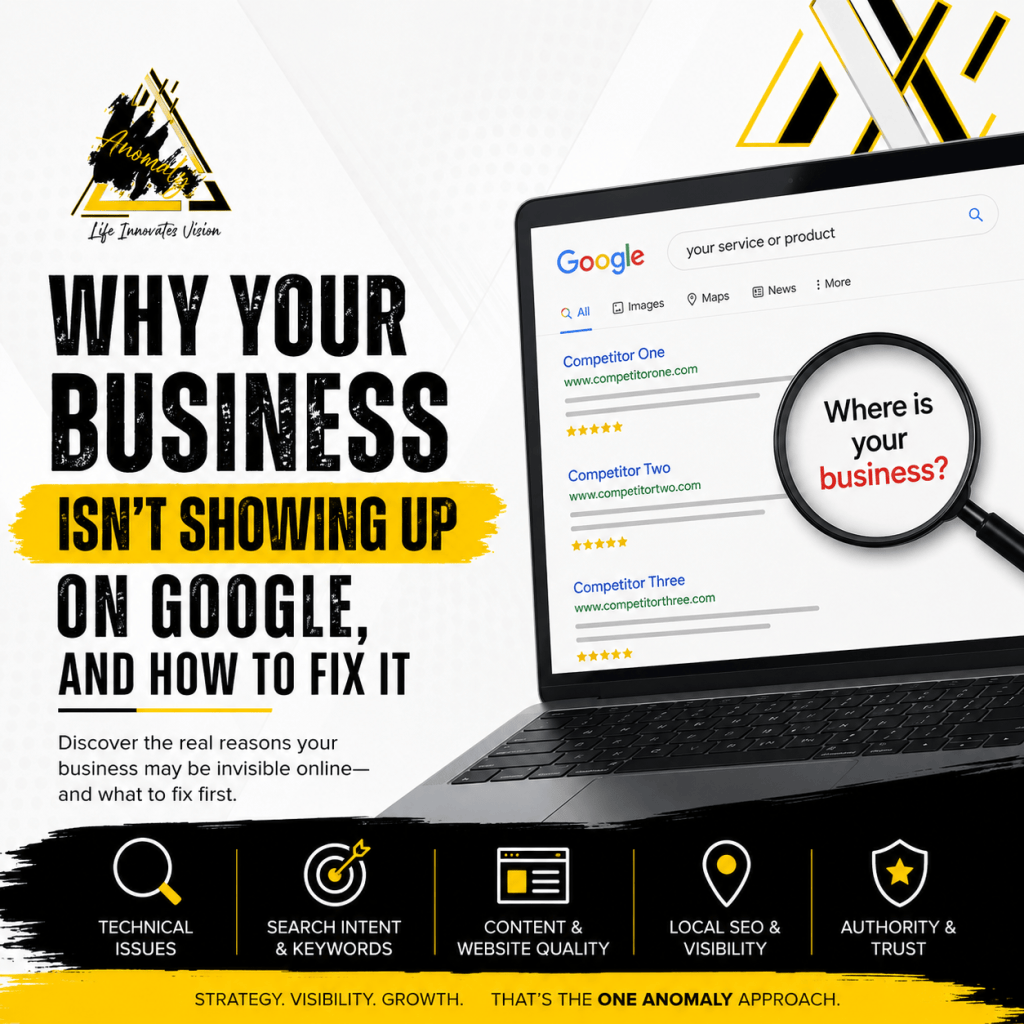
Your business is established. You have a website. You may already have customers, employees, years of experience, and a marketing budget.
But when you search Google for the services your business provides, your competitors appear, and you don’t.
So, why isn’t your business showing up on Google?
The most common reasons are that Google hasn’t indexed your website properly, your website doesn’t clearly communicate what you offer, your pages aren’t strong enough to rank for the searches you’re targeting, your competitors have greater online authority, or your local Google presence needs improvement.
But there’s an important distinction.
If someone searches your company name and finds you, but searches for the service you provide and finds your competitors instead, your business is technically on Google.
The bigger problem is that you’re not being discovered by potential customers who don’t already know you exist.
That’s not simply an SEO issue. It’s a customer acquisition opportunity you’re potentially missing.
First: Are You Missing From Google or Just Not Ranking?
Before rewriting your website, publishing more blogs, or spending more on advertising, determine what “not showing up” actually means.
Your business doesn’t appear when you search its name
This could indicate an indexing or technical problem. For businesses serving a particular geographic market, it may also involve your Google Business Profile.
Your business appears by name but not for your services
This is different, and often more commercially significant. Imagine a company called ABC Accounting. Someone searching “ABC Accounting” already knows the business exists. Someone searching “corporate accounting services” has a need but may not have chosen a provider.
That second search represents an opportunity to acquire a customer.
If competitors consistently appear for the services you sell while your business does not, the problem may involve your content, website structure, relevance, authority, local SEO or competitive positioning.

Your website appears in Google but not Google Maps
Traditional organic rankings and local search results aren’t identical. If your business relies on customers within a particular location, your Google Business Profile and local SEO signals need to be evaluated separately.
Understanding which problem you have prevents you from spending money fixing the wrong thing.
How Do You Know If Google Has Indexed Your Website?
Google Search Console should be one of your first stops.
Its URL Inspection tool can show whether Google has indexed individual pages and identify potential problems. Start with your commercially important pages:
- Homepage
- Main service or product pages
- Location pages
- Important landing pages
- High-value articles
If an important page isn’t indexed, it cannot generate organic search traffic.
But remember:
Indexed does not mean ranked.
Being indexed means Google knows the page exists and it may be eligible to appear in search results. It does not mean Google considers it one of the best results for the searches your customers use.
Think of indexing as entering the competition. Ranking is competing well enough to be seen.
7 Reasons Your Business May Not Be Showing Up on Google
Once you know Google can access your website, the next question is why it isn’t performing.
1. Google Can’t Properly Access Your Website
Important pages can sometimes be blocked from search because of technical issues involving noindex directives, robots.txt rules, redirects, incorrect canonical tags, broken internal links or problems created during a website migration.
This deserves particular attention after a website redesign.
A company can spend thousands creating a beautiful new website and unintentionally lose existing Google visibility if valuable pages disappear or URLs change without the right redirects.
What to do: Check Google Search Console for indexing problems and make SEO part of website redesigns and migrations before the new site launches, not after traffic disappears.
2. Your Website Doesn’t Clearly Explain What You Do
Visit your homepage and ask:
Could someone unfamiliar with our company understand what we sell within a few seconds?
Many business websites rely heavily on language such as:
“Innovative solutions for a changing world.”
“Your trusted partner.”
“Excellence without compromise.”
It may sound professional, but it doesn’t tell a prospective customer — or Google — very much about what the company actually provides.
If you offer corporate accounting, commercial security, logistics consulting, or marketing strategy, your website needs to communicate that clearly. This doesn’t mean stuffing keywords into every paragraph.
It means matching your brand language to the terminology customers use when searching.
Business impact: Unclear positioning doesn’t only affect Google rankings. Even when someone reaches your website, they may leave because they can’t quickly determine whether you can solve their problem.
3. You’re Targeting Keywords Instead of Customer Intent
Not every Google search is equally valuable.
Compare:
“What is marketing?”
with:
“Marketing strategy consultant for growing business.”
The first may generate far more searches. The second may be significantly more valuable to a marketing consultancy. This is why successful SEO shouldn’t be measured by traffic alone.
A business with 20,000 monthly website visitors isn’t necessarily outperforming one with 2,000 if the smaller audience generates more qualified enquiries and revenue.
Your SEO strategy should focus on the intersection between:
- What your ideal customers search for
- Problems your business can genuinely solve
- Where those customers are in their buying journey
- Which searches have realistic commercial value
Common mistake: Choosing topics simply because SEO software reports high search volume.
Better approach: Prioritize searches that can bring the right potential customers into your business, not simply the largest possible audience.
4. Your Service Pages Aren’t Strong Enough to Compete
A common business website has one Services page listing several offerings, each explained in two or three sentences. That may be enough for someone who already knows your company. It may not be enough for someone comparing providers, or for competitive organic search.
Where appropriate, commercially important services should have dedicated pages explaining:
- What the service is
- The problem it solves
- Who it’s appropriate for
- What the process involves
- The outcomes it is designed to support
- Why your company is credible
- Frequently asked questions
- The logical next step
The objective isn’t to make pages unnecessarily long. It’s to make them genuinely useful.
A strong service page should help a prospective customer determine: “Is this the solution I need, and is this a company I should consider?”
5. Your Website Doesn’t Demonstrate Enough Expertise
A website consisting only of Home, About, Services, and Contact pages gives prospective customers, and search engines limited information about what your company knows.
This is where strategic content becomes valuable. But that doesn’t mean publishing generic blogs every week because someone said “Google likes fresh content.”
Your content should answer questions potential customers research before making purchasing decisions.
For example:
- Why aren’t our Google Ads generating leads?
- Should we redesign our website before advertising?
- How do we improve lead generation?
- How much should an established company spend on marketing?
- Why is our marketing generating activity but not sales?
These aren’t simply “blog topics.”
They’re business problems being researched by potential customers.
A focused library of useful content around those problems can demonstrate expertise while attracting people at different stages of a commercial decision.
Ten strategically relevant articles can be more valuable than 100 generic ones attracting readers who will never become customers.
6. Your Competitors Have Stronger Online Authority
Your competitors may rank above you even when your services are comparable — or better.
Why?
Google doesn’t know your business the way your customers do.
Competitors may have stronger signals such as:
- Links from reputable websites
- Industry mentions
- Media coverage
- Customer reviews
- Professional association listings
- Partnerships
- Useful original resources
- A stronger digital brand presence
This creates a particular challenge for established businesses.
A company may have operated successfully for 15 years, worked with major customers and built an excellent industry reputation while its online presence communicates almost none of that credibility.
Meanwhile, a younger competitor may have deliberately built a stronger digital footprint.
Your online authority should reflect the authority your business has earned offline.
7. Your Google Business Profile Needs Attention
For businesses serving customers in a specific geographic market, your Google Business Profile can play an important role in local visibility.
Google explains that local search results are primarily influenced by relevance, distance and prominence.
Review whether your profile accurately reflects your:
- Business category
- Address or service area
- Opening hours
- Contact details
- Website
- Services
- Photos
- Customer reviews
Reviews matter beyond SEO.
Imagine a potential customer comparing three unfamiliar businesses. One has complete information, professional imagery and recent positive reviews. Another has an incomplete profile and its most recent review is three years old.
Visibility got the businesses into consideration.
Credibility may determine which one gets the enquiry.
And remember that geography matters. Local search results can vary based on where the person searching is located, so repeatedly Googling your company from your office doesn’t necessarily show you what prospective customers see.
Why Does Your Business Show Up by Name but Not for Its Services?
For an established company, this may be the most important issue in this article. There is a significant difference between branded and non-branded search.
A branded search might be:
“ABC Engineering”
A non-branded search might be:
“commercial engineering consultant”
Someone making the first search already knows ABC Engineering exists.
Someone making the second has a need but hasn’t necessarily selected a company.
That person represents potential new customer acquisition.
So don’t evaluate your Google visibility simply by searching your company name.
Ask:
When prospective customers who don’t know our company search for the problems we solve or services we provide, are we part of the consideration set?
If the answer is consistently no, you have a much more meaningful marketing problem to investigate.
Why Are Your Competitors Ranking Above You?
Competitors aren’t necessarily ranking higher because they’re better businesses. Their digital presence may simply give Google stronger reasons to consider them relevant. They may have better service pages, stronger content, more reputable websites referencing them, more customer reviews or years of consistent SEO development.
Competitive research can help identify those gaps. But don’t simply copy whoever ranks first.
Instead, determine:
What does this page answer well? What does it miss? What does the searcher actually need? And what can our business contribute that is genuinely more useful?
That’s how you build an advantage rather than another version of what’s already ranking.
How Do You Fix a Business That Isn’t Showing Up on Google?
The exact solution depends on the problem, but a sensible process is:
- Confirm indexing. Make sure Google can access your important pages.
- Resolve technical problems. Remove barriers preventing proper crawling and indexing.
- Identify commercially valuable searches. Understand what your ideal customers actually search for.
- Strengthen your positioning. Clearly communicate what you provide, who it’s for and why it matters.
- Improve important service pages. Give high-value offerings enough depth to compete and convert.
- Develop useful supporting content. Answer real questions customers ask before purchasing.
- Strengthen local visibility and authority. Improve your Google Business Profile, reviews, mentions and credible links.
- Measure what matters. Evaluate whether increased visibility is producing qualified enquiries and commercial opportunities.
That last step is crucial.
More traffic isn’t automatically better marketing.
If organic traffic doubles but qualified enquiries remain unchanged, you’ve gained an audience — not necessarily a customer acquisition channel.
How Do You Know If Your SEO Is Actually Working?
Don’t judge SEO purely by whether one keyword moved from position eight to position four.
For an established business, the more useful questions are:
- Are we appearing more often for commercially relevant searches?
- Are more people discovering us without already knowing our company name?
- Are important service pages receiving qualified traffic?
- Are organic visitors becoming enquiries?
- Are those enquiries turning into genuine sales opportunities?
- Is organic search contributing to pipeline or revenue?
SEO metrics matter.
But ultimately, marketing should support business performance.
Can You Fix Your Google Visibility Yourself?
Sometimes, yes.
An incomplete Google Business Profile, obvious indexing problem or basic page issue may be perfectly manageable internally.
Professional strategic support becomes more relevant when your business is established but search visibility consistently underperforms, competitors dominate commercially important searches, your website needs restructuring, you’re preparing to increase advertising, or your marketing activity isn’t generating enough qualified opportunities.
At that stage, the question becomes bigger than:
“How do we rank higher?”
It becomes:
“Where is our customer acquisition strategy underperforming, and what should we prioritize fixing?”
That’s a very different conversation.


Frequently Asked Questions
Why is my business not showing up on Google?
Your website may not be indexed correctly, Google may not clearly understand your services, your content may not match relevant searches, competitors may have stronger authority, or your local Google presence may need improvement. Start by determining whether you have an indexing, ranking or local visibility problem.
How do I get my business to show up on Google?
Ensure Google can crawl and index your website, create clear pages around the services customers actually search for, optimize your Google Business Profile where relevant, publish useful supporting content, and build credible online authority.
Why does my business show up by name but not for my services?
Google recognizes your brand but may not consider your website sufficiently relevant or authoritative for broader service-related searches. Investigate your service pages, content, search intent, authority and competitive positioning.
Why are my competitors ranking higher on Google?
Their websites may better match search intent, have stronger service pages, more authority, better local signals, more reviews or a longer history of consistent SEO activity. Competitive analysis can help identify which gaps actually matter.
Do I need SEO if I already have a website?
A website makes your business available online. SEO helps potential customers discover it. If customers actively search for your services and consistently find competitors instead, having a website alone isn’t solving the acquisition problem.
Being on Google Isn’t the Goal. Being Found by the Right Customers Is.
Your business doesn’t need to rank first for every keyword in your industry.
It needs to be visible where that visibility can contribute to qualified leads, customer acquisition and profitable growth.
That requires more than adding keywords to a website.
Your positioning needs to be clear. Your important services need strong pages. Your content should answer genuine customer questions. Your online authority should reflect your real-world credibility. And once prospective customers find you, your website needs to give them a reason to take the next step.
That’s where SEO stops being an isolated marketing tactic and becomes part of your wider Marketing and Business Development strategy.
If your business is established but you’re struggling to understand why competitors are easier to find, why your website isn’t generating enough qualified enquiries, or where to invest next, spending more on random marketing tactics isn’t necessarily the answer.
One Anomaly can assess how your search visibility, website, positioning, Marketing Strategy and Business Development efforts work together, identify where opportunities may be getting lost and determine what is commercially worth fixing before you increase your marketing investment.
Request a Marketing & Business Development Consultation with One Anomaly to identify what’s limiting your visibility, and what your business should prioritize next.
Learn More
Why Isn’t My Marketing Working? 9 Reasons Businesses Struggle to Grow
Your business is marketing, but the leads and growth aren’t following. Discover nine reasons marketing underperforms—and how to identify what’s actually holding your business back before spending more.

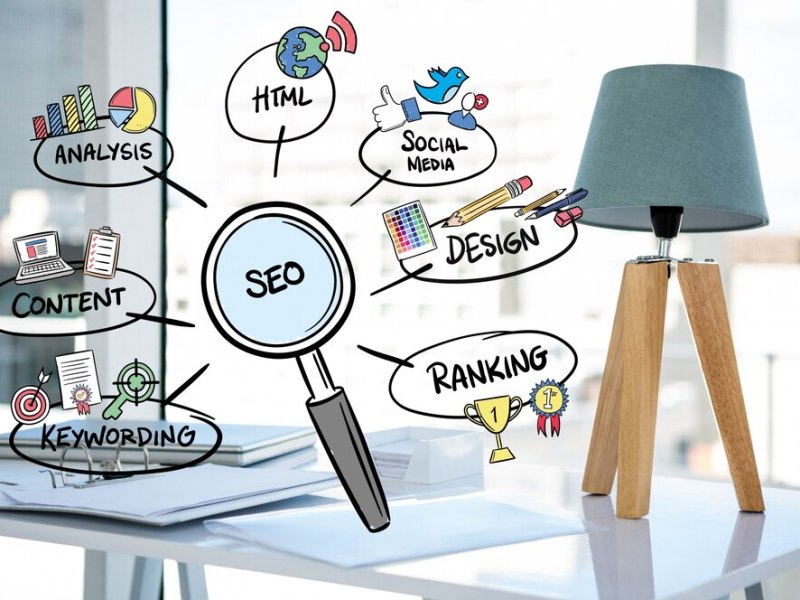
Why Your Business Isn’t Showing Up on Google And How to Fix It
If your business isn’t showing up on Google, it’s not bad luck, it’s a visibility problem you can fix. From optimizing your website’s speed and keywords to claiming your Google Business Profile and publishing content that builds authority, this guide breaks down the exact steps to help your business rank higher, attract organic traffic, and…

The Missed Opportunity Most Businesses Ignore
Most Caribbean businesses are chasing attention on Instagram and Facebook, but the real opportunity is where customers are already searching: Google. 🌍 Over 68% of all online experiences begin with a Google search, yet many small businesses across the region remain invisible when potential customers look for their services. The truth is, you don’t need…

What do you think?