
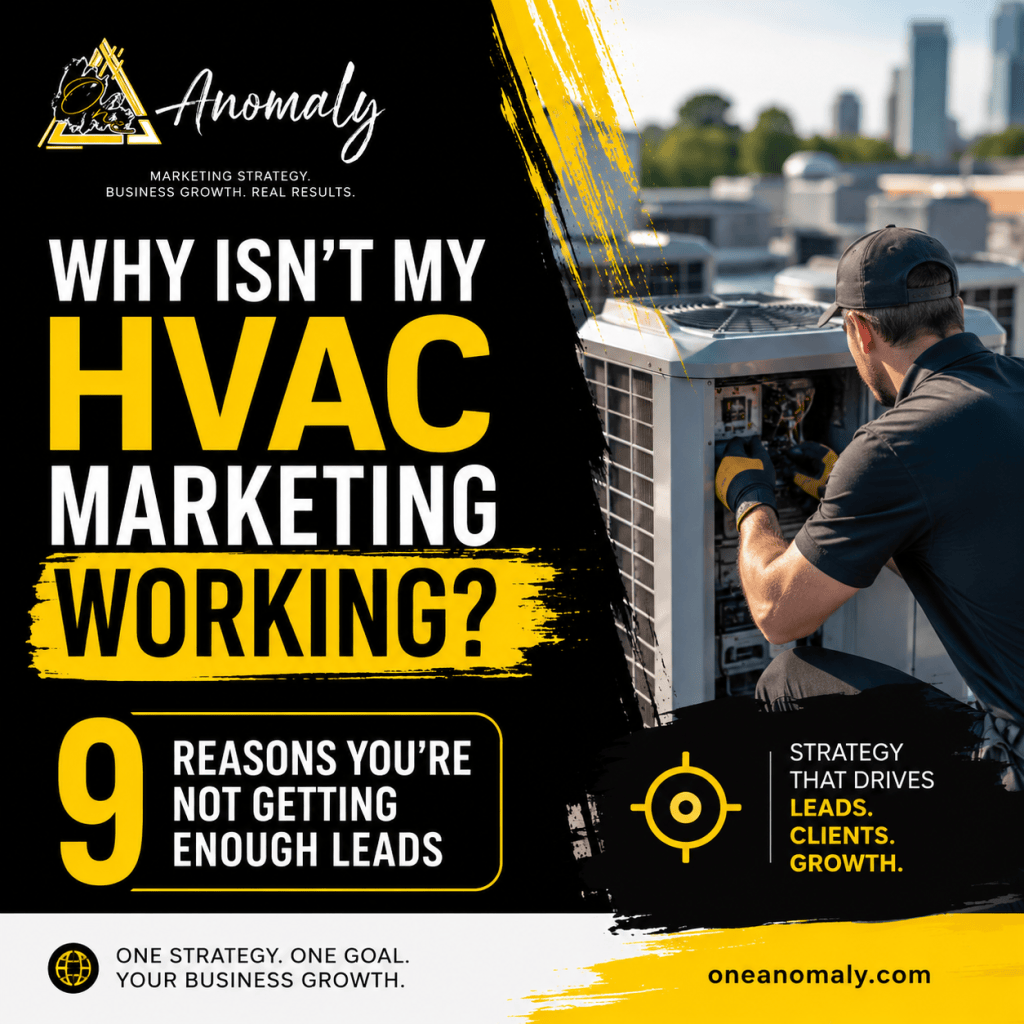
If your HVAC company is investing in marketing but still isn’t generating enough qualified leads, the problem may not be that you need more marketing.
You may need a better strategy.
An established HVAC company can have a professional website, active social media accounts, Google Ads, SEO, a Google Business Profile, and even an outside marketing provider and still struggle to generate predictable growth.
That’s because marketing activity and business growth are not the same thing.
Effective HVAC marketing should create a measurable path from visibility to leads, leads to booked appointments, booked appointments to customers, and customers to revenue.
When one part of that system breaks down, increasing your marketing budget can simply make the inefficiency more expensive.
So before deciding that SEO isn’t working, Google Ads cost too much, your website needs another redesign,
or your marketing company isn’t generating enough leads, determine where the customer acquisition system is actually failing.
Here are nine reasons your HVAC marketing may not be producing the leads and growth you expected.
1. You Have Marketing Tactics, But No Marketing Strategy
One of the biggest differences between marketing activity and marketing strategy is that strategy starts with the business objective.
Your company may already be doing plenty of marketing.
Someone manages social media. Another provider handles Google Ads. Your website company works on SEO. Your team collects customer reviews. You may also be paying for directory listings or third-party lead generation.
Everyone is doing something.
But what connects it all?
An HVAC marketing strategy should establish what the company is trying to accomplish commercially and determine which marketing activities are most likely to support that objective.
What should an HVAC marketing strategy actually define?
At minimum, you should know which services you most want to grow, which customers you want to attract, which geographic areas offer the greatest opportunity, how much additional work your company can realistically handle and how marketing performance will be connected to revenue.
Consider two HVAC companies.
Company A wants “more leads.”
Company B wants to increase residential HVAC replacement installations within three profitable service areas while building its maintenance agreement customer base.
Company B can build a strategy around a measurable commercial objective.
Company A has a wish.
Before adding another marketing channel, campaign or monthly expense, define what the business actually needs marketing to accomplish.
2. You’re Targeting More Leads Instead of the Right Leads
Not every HVAC lead has equal commercial value.
A homeowner requesting routine maintenance, a property manager searching for an ongoing commercial HVAC provider and a homeowner considering a complete system replacement represent very different opportunities.
Yet many companies evaluate marketing using one number:
How many leads did we get?
That number alone can be misleading.
Imagine Campaign A generates 100 inquiries while Campaign B generates only 40.
Campaign A initially appears more successful.
But what if Campaign B produces more booked appointments, higher-value jobs and greater gross profit?
Suddenly the campaign generating fewer leads may be creating significantly more value for the business.
The goal should not simply be maximum lead volume.
It should be acquiring enough of the right customers at an economically viable cost.
Your marketing strategy should therefore consider the services you want to sell, geographic coverage, margins, operational capacity, seasonality and the potential lifetime value of different customers.
You may discover that you don’t need another 500 inquiries.
You need 75 highly qualified opportunities for the services your company actually wants to grow.
That distinction should influence everything from your SEO keywords and Google Ads campaigns to your landing pages, website messaging and advertising budget.
3. Customers Can’t Find You When They’re Ready to Buy
HVAC services can involve extremely high commercial search intent.
Someone whose air conditioning stops working during a heat wave is unlikely to spend three weeks casually researching HVAC companies.
Someone whose heating system fails during winter probably isn’t opening Instagram hoping an HVAC company’s latest Reel appears.
They have a problem.
They need a solution.
And they’re searching for a company capable of providing it.
Your business needs to be visible during those moments.
That means understanding the role of local SEO, your Google Business Profile, customer reviews, organic search visibility, paid search and other search-driven acquisition channels.
But simply “being on Google” isn’t enough.
Your HVAC company may rank first when someone searches for your business name while being virtually invisible when potential customers search for the actual services you provide.
Those are very different things.
You need to understand which commercially valuable searches potential customers are making, whether your business appears for those searches, what competitors appear instead and whether the pages Google is directing customers to are capable of converting that interest.
This is why SEO should never be judged simply by how many keywords your website ranks for.
Ranking for hundreds of informational searches that rarely produce customers may be less commercially valuable than strong visibility for a smaller number of high-intent local searches.
The question isn’t simply:
Are we ranking?
It is:
Are the right potential customers finding us when they need the services we want to sell?
4. Your Website Gets Traffic But Doesn’t Convert It
Getting someone onto your HVAC website isn’t the win.
Getting the right visitor to take the next commercial step is.
Within seconds of arriving, a potential customer should be able to understand:
Do you provide the service I need?
Do you service my location?
Why should I trust your company?
Can you solve my problem?
What should I do next?
If those answers are buried beneath generic copy, confusing navigation, slow pages or weak calls to action, your website creates friction exactly when a potential customer is deciding whom to contact.
This becomes particularly expensive when you’re paying for traffic.
Suppose your HVAC company increases its advertising budget and doubles the number of visitors reaching the website.
Sounds great.
But if the website doesn’t effectively convert those visitors into inquiries, you’ve simply paid more money to send additional people into a system that isn’t working.
Congratulations. You scaled the leak.
Your website therefore needs to be evaluated as part of your sales infrastructure, not simply as an online brochure.
Look beyond traffic.
Measure phone calls, booking requests, quote requests, form submissions, landing-page conversion rates and, eventually, how those inquiries translate into booked work.
5. Your Marketing Looks and Sounds Like Every Other HVAC Company
Visit five HVAC company websites operating in the same market and you’ll probably encounter variations of the same promises:
Quality service.
Experienced technicians.
Reliable solutions.
Customer satisfaction.
Serving the community.
There is nothing inherently wrong with these claims.
The problem is that virtually every competitor can make them.
When every company looks interchangeable, potential customers need another way to decide.
That often means reviews, availability or price become disproportionately important.
Strong positioning helps customers understand why your company is the appropriate choice for a particular problem or customer.
Perhaps your advantage is expertise with complex commercial HVAC systems.
Maybe it’s your emergency response capabilities.
Perhaps your company specializes in high-efficiency systems, has an unusually strong preventative maintenance program or has extensive experience servicing particular property types.
Whatever your advantage is, it needs to be genuine, commercially relevant and consistently communicated.
Positioning isn’t about inventing a clever tagline.
It’s about giving the market a meaningful reason to choose you.
6. You’re Losing Leads After Marketing Generates Them
Sometimes the marketing isn’t the problem at all.
A prospective customer finds your company.
They click.
They call.
Nobody answers.
Or they complete a website form at 9:15 in the morning and don’t hear from anyone until late afternoon.
Meanwhile, they contacted three competitors.
Your marketing successfully generated an opportunity.
Your business lost it.
This is where marketing, sales and operations start overlapping.
For an established HVAC business, lead handling should be treated as part of the customer acquisition system.
You need to understand what happens after someone makes contact.
Who answers incoming calls?
What happens to missed calls?
How quickly are online inquiries contacted?
Are estimates followed up?
Are opportunities recorded in a CRM or another system?
Can management see how many leads become booked appointments?
Can you see how many appointments become customers?
If you’re spending thousands of dollars every month generating opportunities while your internal process quietly loses a significant percentage of them, increasing advertising isn’t necessarily the first solution.
Fix the leak before increasing the water pressure.
7. You’re Marketing Reactively Around HVAC Seasonality
HVAC demand is seasonal in many markets.
Your marketing strategy should know that before the weather changes.
Unfortunately, many businesses market reactively.
Business slows.
Management becomes concerned.
Advertising increases.
Calls return.
The team gets busy.
Marketing becomes less important.
Demand eventually falls.
Management becomes concerned again.
And the cycle repeats.
That’s not a growth strategy.
That’s a thermostat.
A stronger HVAC marketing strategy works ahead of demand rather than chasing it.
For example, an HVAC company operating in a colder market can begin building heating-related visibility before winter demand peaks.
Fall can support furnace inspections, preventative maintenance, replacement planning, heating-related SEO content and reactivation campaigns targeting existing customers.
Spring can prepare the business for cooling demand.
Shoulder seasons can support maintenance agreements, replacement education, customer retention and commercial business development.
The exact strategy depends on your climate, service mix, capacity and market.
But the principle remains the same:
Marketing should anticipate your revenue cycle, not react to it.
8. You Don’t Know Which Marketing Is Producing Revenue
Ask a simple question:
How much revenue did our marketing generate last quarter?
Can your company answer it?
Or can your marketing reports tell you impressions, clicks, rankings, website visitors, followers and leads?
Those numbers aren’t useless.
They help diagnose marketing performance.
But they are not the final commercial outcome.
For an established HVAC business, measurement needs to move further down the funnel.
You should increasingly understand:
Traffic: Are the right prospects finding us?
Leads: Are they qualified opportunities?
Cost per lead: What are we paying to generate an inquiry?
Booking rate: How many inquiries become appointments?
Close rate: How many opportunities become paying customers?
Customer acquisition cost: What does acquiring a new customer actually cost?
Average job value: How much revenue are those customers generating?
Revenue by source: Which marketing channels are producing actual business?
Repeat revenue: What happens financially after the first job?
Without this visibility, marketing decisions are based primarily on activity rather than economics.
And that makes it difficult to know what to stop, what to fix and what deserves more investment.
9. You’re Trying to Fix a Strategy Problem by Spending More on Advertising
This may be the most expensive mistake on the list.
Paid advertising can be extremely effective for HVAC companies because it allows businesses to reach potential customers when they’re actively looking for a solution.
But advertising amplifies the system you already have.
If your positioning is weak, your website doesn’t convert, your lead handling is inconsistent and you can’t accurately attribute revenue, increasing your advertising budget doesn’t automatically solve those problems.
It may simply expose them faster.
Before significantly increasing advertising spend, ask:
Can we clearly identify the customers and services we’re targeting?
Do we have landing pages capable of converting that demand?
Can we respond quickly to the additional leads?
Do we have enough technicians and operational capacity to service the additional work?
Can we track leads through to booked jobs and revenue?
Do our margins support what we’re paying to acquire customers?
These questions become particularly important for companies considering significant monthly advertising budgets.
A $10,000 monthly advertising budget becomes $120,000 in media spend over a year.
At that level, “let’s run some ads and see what happens” isn’t a marketing strategy.
It’s an expensive experiment.
How Do You Know Which HVAC Marketing Problem You Actually Have?
Start with revenue and work backwards.
If revenue isn’t growing at the rate you expected, determine where performance begins to break down.
If you have plenty of qualified appointments but not enough sales, you may have a closing or sales problem.
If you have plenty of inquiries but few appointments, investigate lead quality and booking.
If your website receives relevant traffic but generates few inquiries, investigate conversion.
If qualified customers aren’t reaching your website at all, investigate search visibility, advertising and demand generation.
If every marketing provider is working independently toward different goals, you may have a strategy problem.
This matters because the wrong diagnosis creates the wrong investment.
You don’t want to spend another $5,000 generating leads if your business is already losing the leads it receives.
You don’t want another website redesign if the website isn’t actually the bottleneck.
And you don’t want to abandon SEO because revenue isn’t increasing when the actual problem occurs after the phone rings.
The objective is to identify exactly where the path between attention and revenue is breaking.
When Should an HVAC Company Bring in Strategic Marketing Support?
Not every HVAC company needs an outside marketing strategy partner.
If your internal team understands your market, has a clear customer acquisition strategy, can execute across the necessary channels and can confidently connect marketing investment with revenue, keeping strategy internally may make complete commercial sense.
External strategic support becomes more valuable when the business reaches a different level of complexity.
You may have several marketing providers but no unified strategy.
You may be preparing for expansion into new geographic markets.
You may want to aggressively grow particular service lines.
You may already be spending significantly on advertising without being confident about the return.
Marketing activity may have increased while revenue growth has plateaued.
Or management may simply lack the time or specialist expertise to objectively diagnose the entire customer acquisition system.
At that point, the requirement isn’t necessarily someone to post more content or launch another advertising campaign.
The business may need someone capable of looking across Marketing Strategy, Business Development, customer acquisition, positioning, digital visibility, advertising and conversion and determining where the commercial gaps actually exist.
That’s a very different conversation.
Frequently Asked Questions About HVAC Marketing
Why is my HVAC company not getting enough leads?
Your HVAC company may have insufficient search visibility, poor targeting, weak website conversion, unclear positioning, ineffective advertising or a fragmented marketing strategy. There may also be a lead-handling problem that makes a lead-generation issue appear worse than it actually is.
Start by determining whether you have a visibility, traffic, conversion, lead-quality, booking or sales problem before increasing your marketing budget.
How can an HVAC company get more qualified leads?
Start by defining which services, customers and geographic markets are most commercially important to the business.
Then align SEO, advertising, website messaging, landing pages and other acquisition activities around those opportunities.
More precise targeting can produce greater commercial value than simply maximizing the total number of inquiries.
What is the best marketing strategy for an HVAC company?
There is no single marketing channel that is best for every HVAC company.
The appropriate strategy depends on your market, service mix, growth goals, competition, margins, operational capacity and existing customer base.
For many established HVAC businesses, the strongest strategy combines channels that capture immediate demand, such as local SEO and paid search, with activities designed to strengthen reputation, retention, customer lifetime value and future demand.
How do I know if my HVAC marketing is working?
Don’t stop at impressions, clicks, traffic or even lead volume.
Track how marketing contributes to qualified inquiries, booked appointments, sales, customer acquisition costs, average job value and revenue.
The further you can connect marketing activity with actual business outcomes, the better equipped you are to decide where future investment should go.
Should my HVAC company use Google Ads?
Google Ads can make commercial sense when sufficient search demand exists, your targeting is strong, the economics of customer acquisition are viable and your business can effectively convert and service the resulting opportunities.
Advertising should be evaluated as part of the wider customer acquisition system rather than treated as an isolated marketing tactic.
Should I increase my HVAC advertising budget if I need more leads?
Not automatically.
First determine whether your current campaigns are reaching the right prospects and whether your website, lead handling, sales process and operational capacity are converting those opportunities efficiently.
If those systems are performing well and additional market demand exists, increasing investment may make sense.
If they’re not, scaling the budget may scale the waste.
More Leads Aren’t the Goal. Profitable Growth Is.
When HVAC marketing isn’t producing the results you expected, the natural reaction is often to do more.
Post more.
Spend more.
Launch another campaign.
Hire another provider.
But more activity doesn’t necessarily solve the underlying problem.
An established HVAC company should be able to see a logical path from marketing investment to qualified opportunities, booked work and profitable revenue.
If that path isn’t clear, diagnosis should come before additional spending.
At One Anomaly, our approach to Marketing Strategy and Business Development looks beyond individual marketing tactics. We examine how positioning, customer acquisition, digital visibility, advertising, conversion and business development work together to support wider growth objectives.
If your HVAC company is already investing in marketing but you cannot confidently determine where leads are being lost, which activities are producing revenue or what you should scale next, bringing in an external strategic perspective may be the logical next step.
Before increasing your advertising budget or adding another marketing tactic, let’s identify what’s actually preventing your current marketing from becoming measurable business growth.
Email One Anomaly at info@oneanomaly.com to discuss your current marketing and growth challenge.

What do you think?