
Your service business has reached the point where marketing can no longer be handled whenever someone has time.
You need consistent lead generation, stronger SEO, paid advertising, content, reporting and a strategy connecting those activities to revenue.
Now comes the decision:
Should you hire an in-house marketer or work with a marketing agency?
Neither is automatically better.
In-house marketing generally provides deeper company knowledge, closer day-to-day involvement and greater control. A marketing agency can provide broader specialist expertise, an outside perspective and access to capabilities that may require several internal hires to replicate.
For many growing businesses, the answer eventually becomes a combination of both.
The right question isn’t simply:
“Which option costs less?”
It’s:
“Which structure gives our business the capabilities it needs to achieve its next stage of growth?”
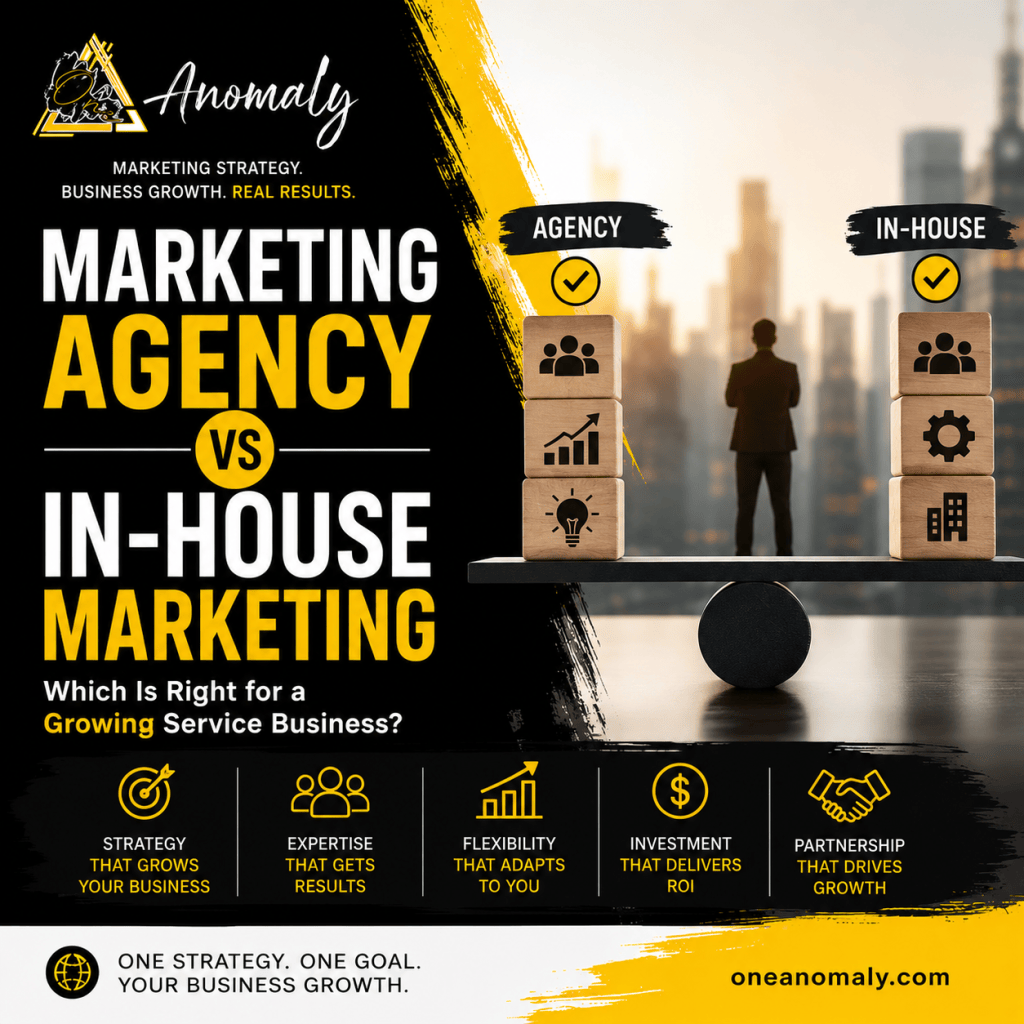
Marketing Agency vs In-House: What’s the Difference?
An in-house marketing team consists of employees working exclusively for your company.
A marketing agency provides external specialists under a service agreement or retainer.
Here’s the practical difference:
| In-House Marketing | Marketing Agency |
|---|---|
| Dedicated exclusively to your company | Works across multiple clients |
| Deep internal knowledge | External market perspective |
| Direct daily access | Structured communication |
| Requires recruitment and management | Existing team and infrastructure |
| Expertise depends on who you hire | Access to multiple specialists |
| Fixed employment structure | Easier to adjust scope as needs change |
The decision becomes more complicated when you consider what modern marketing actually requires.
1. Compare Capabilities, Not One Salary Against One Retainer
This is where businesses often get the calculation wrong.
They compare:
One marketing employee = $X salary
against:
Marketing agency = $X monthly retainer
Those aren’t necessarily equivalent resources.
A growing service business may need marketing strategy, SEO, Google Ads, analytics, content, website conversion, social media, email marketing and lead generation.
Finding one person who performs every discipline at an expert level is unlikely.
As your company grows, the challenge becomes less about simply doing more marketing and more about deciding which activities deserve resources and who should be responsible for them. If you’re still determining the appropriate mix, our guide to 25 Marketing Ideas for 2025: Scalable Strategies for Entrepreneurs and Small Businesses explores different approaches businesses can consider as they grow.
So don’t ask:
“Is an agency cheaper than hiring a Marketing Manager?”
Ask:
“What capabilities does our growth strategy require, and what would it cost to build equivalent capability internally?”
That’s a much fairer comparison.
2. When Does In-House Marketing Make More Sense?
There are situations where building internally is absolutely the stronger decision.
An in-house team has one enormous advantage:
They live inside the business.
They hear customer conversations, interact with sales and operations, understand the company’s services intimately and experience internal changes as they happen.
That institutional knowledge compounds over time.
In-house marketing can make particular sense when your company has enough continuous marketing work to justify dedicated specialists, the budget to hire the appropriate talent and leadership capable of managing marketing effectively.
It can also be valuable when marketing needs to be deeply integrated into daily operations.
But there’s an important distinction:
Hiring one marketer isn’t necessarily the same as building a marketing department.
If you expect one employee to be your strategist, copywriter, graphic designer, SEO specialist, Google Ads expert, videographer, social media manager and analyst, you’ve probably designed the role incorrectly.
3. When Does Hiring a Marketing Agency Make More Sense?
An agency becomes particularly attractive when your business needs multiple marketing capabilities but isn’t ready to build an entire internal department.
This is common among growing service businesses.
You may already have revenue, employees and a strong service offering, but marketing has become fragmented.
Your website company handles the website.
Someone posts on social media.
A freelancer manages ads.
Management occasionally handles Business Development.
Nobody owns the complete growth strategy.
This is often part of a wider scaling problem. Growth eventually forces business owners to decide which capabilities genuinely need to exist internally and which can be handled more efficiently by outside specialists.
We explore that broader decision in Scaling Your Service Business: 5 High-Impact Steps, including how outsourcing can help growing companies address capacity and specialist skill gaps.
A strong agency can also provide something that’s harder to manufacture internally:
An external perspective.
Internal teams can become accustomed to how the company has always marketed itself.
A strategic partner should be willing to question assumptions, analyze competitors, identify gaps and challenge marketing activity that isn’t producing commercial value.
That objectivity becomes particularly useful when a company has increased its marketing activity but growth has plateaued.
4. Which Option Gives You More Control?
In-house wins here.
You can change priorities quickly and involve marketing directly in daily decisions.
But more control doesn’t automatically produce better marketing.
If leadership constantly changes campaigns, overrides strategy or makes decisions based on personal preferences instead of customer behavior and data, increased control can actually damage performance.
Agency relationships require a different structure.
You need clear objectives, defined responsibilities, access to information and regular communication.
A strong agency shouldn’t operate independently from the business.
It should operate outside the company but inside the strategy.
Regardless of which model you choose, your business should also retain appropriate ownership and access to critical assets, including advertising accounts, analytics platforms, website properties and customer data.
5. Which Is More Cost-Effective: An Agency or In-House Marketing?
Cost matters.
But calculate the real cost.
An employee costs more than salary. Depending on your location and employment structure, you may also need to account for benefits, payroll-related expenses, recruitment, software, equipment, training and management time.
An agency retainer may appear expensive until you compare it against building equivalent specialist capability internally.
But the opposite can also be true.
A substantial agency engagement can cost more than an individual employee.
That’s why price alone doesn’t answer the question.
Evaluate:
Cost → Capability → Execution → Leads → Customers → Revenue
If the less expensive option cannot deliver the capabilities the business actually needs, it may not be the more economical choice.
6. Don’t Ignore the Hybrid Marketing Model
The decision doesn’t have to be agency or in-house.
For many growing service businesses, the strongest long-term structure may eventually be both.
For example, an internal Marketing Manager might own company knowledge, priorities, approvals and internal coordination while an external partner provides strategy, SEO, paid advertising, lead generation or other specialist capabilities.
That prevents an internal employee from being expected to master every marketing discipline while allowing the company to maintain strong internal ownership.
The same principle applies elsewhere when scaling a company. Growing businesses can use lean internal teams supported by external specialists rather than assuming every new capability requires another full-time employee.
Our guide to How to Scale a Business Remotely: 7 Proven Models Working in 2025 explores this approach further, including distributed teams, freelancers and specialist external support.
The hybrid model can be particularly powerful when the internal and external teams have clearly defined roles.
Without that clarity, you risk paying two teams to duplicate work or, worse, assuming the other team is responsible for something nobody is actually doing.
7. Make the Decision Based on the Problem You’re Solving
Before hiring anyone, identify why your current marketing isn’t enough.
If execution is the problem, you may need additional hands.
If specialist expertise is missing, external support may solve it.
If marketing lacks internal coordination, an in-house leader may be the priority.
If you have plenty of marketing activity but no clear connection between marketing, lead generation, sales and revenue, you may need strategy before additional headcount.
And if you’re considering increasing advertising simply because lead generation isn’t where you want it to be, don’t assume additional spending is automatically the answer.
Before significantly increasing your media budget, assess whether the wider customer acquisition system is ready to convert that investment. Our guide, Before You Spend $10,000 a Month on Advertising, Fix These 7 Things, explains what should be evaluated before scaling advertising.
This is especially important for growing service businesses.
Hiring another person into a broken marketing system doesn’t fix the system.
Neither does hiring an agency.
First diagnose what capability is actually missing.
Frequently Asked Questions
Is an agency better than an in-house marketing team?
Neither is universally better. Agencies can provide broader specialist capabilities and flexibility, while internal teams provide greater daily access and institutional knowledge. The right model depends on your growth stage, objectives and existing capabilities.
Is hiring a marketing agency cheaper than hiring employees?
Sometimes, particularly when you need several specialist disciplines but don’t require each specialist full-time. However, sophisticated agency engagements can also exceed the cost of an individual employee. Compare equivalent capabilities rather than simply comparing salary against retainer.
When should a business bring marketing in-house?
Consider building internally when marketing requires substantial continuous work, your company can justify dedicated roles and you have the leadership and budget required to build and manage the function properly.
Can an in-house marketing team work with an agency?
Absolutely. A hybrid model can give the company internal ownership while providing external expertise for strategy and specialist disciplines.
Build the Marketing Structure Your Next Stage Requires
The agency-versus-in-house decision shouldn’t be about which option makes your company look more established.
It should be about what your business needs next.
If you need deep daily integration and have sufficient work and budget to support a capable internal team, building in-house may be the right investment.
If you need strategic direction and multiple specialist capabilities without building an entire marketing department, an agency may make more commercial sense.
And if both internal knowledge and external specialization matter, the right answer may be hybrid.
At One Anomaly, we approach Marketing Strategy and Business Development around the commercial problem first.
If your service business is growing but you’re unsure whether your next investment should be an internal marketing hire, an agency partner or a combination of both, determining the capabilities you’re actually missing should come before spending the money.
Before adding another marketing expense to payroll or signing another agency retainer, make sure you’re building the right structure for growth. Email One Anomaly at info@oneanomaly.com to discuss your marketing and business growth objectives.

What do you think?